






Based on their Japanese language ability and prior learning experiences, we determine whether students should take each subject with their regular homeroom or in the International Progress Class.
For math, when a student is ready to join the current unit for their grade level, they transition to learning with their homeroom class.
For Japanese language, when a student has developed sufficient reading and writing skills for their grade level, they transition to learning with their homeroom class.
As a general rule, one-on-one instruction is not provided*
In elementary school, the student's homeroom class is the main environment of school life. Since it is natural to learn in a group, the International Progress Class also has a small-group learning environment. By gathering with peers who share similar backgrounds and feelings, students can learn while understanding and supporting each other.
*In some cases, instruction may begin one-on-one depending on the student's level of Japanese proficiency.
Individualized Instruction Based on Students' Skills
We prepare instruction plans based on which subjects to study, at what pace, and in what manner, while also taking into account that the language students use in daily life and the language used for learning may differ depending on how long the students lived overseas and their family structure.
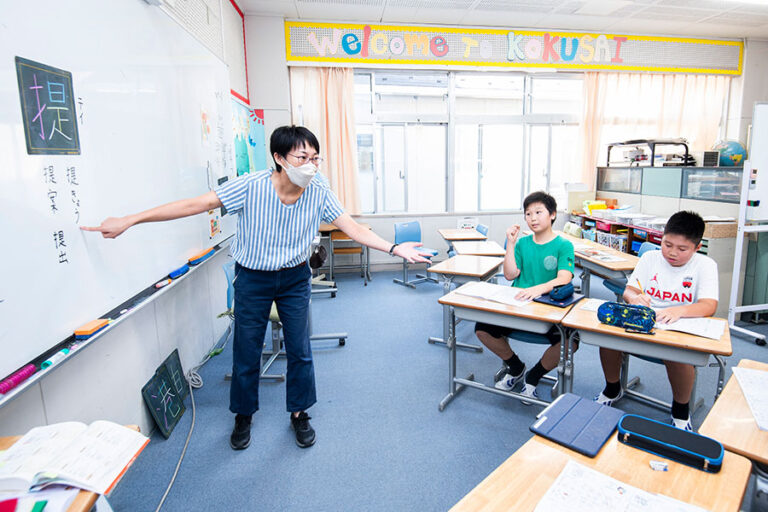
Gradually Building the Ability to Learn in Japanese
In class, teachers closely observe each student's Japanese language ability.
We also use an assessment called Dialogic Language Assessment (DLA) to objectively evaluate students' skills in speaking, listening, reading, and writing.
Based on these assessments, we combine various types of instruction according to each student's needs, such as introductory Japanese lessons, skill-specific Japanese lessons, and Japanese as a Second Language (JSL) lessons, with the goal of strengthening their ability to learn in Japanese.
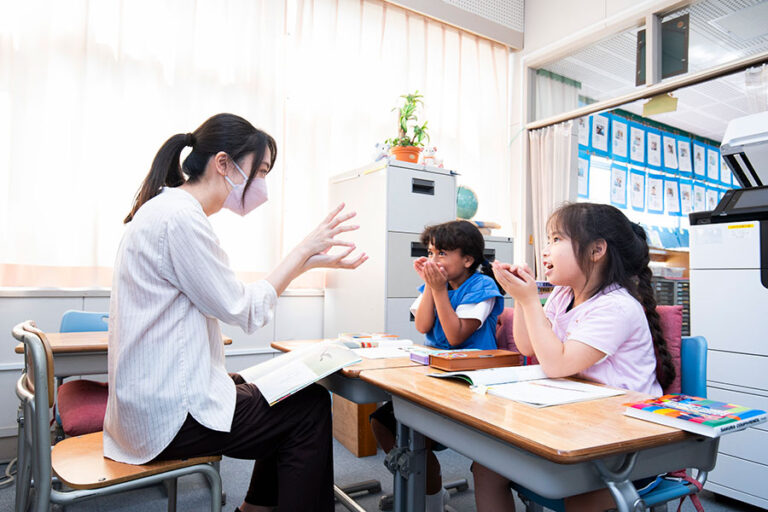
Valuing Communication with Families
In the International Progress Class, we monitor each student's situation on a daily basis.
When needed, we contact families to report on any issues students may face at school or to request support with home study.
By working closely with families, we help ensure that students can engage in their learning with peace of mind and perform to the best of their abilities.
Collaboration with the Homeroom Class
Students spend most of their school life in their assigned homeroom class.
We have a solid support system in which we constantly work with homeroom and subject teachers to stay informed about students' situations in both daily life aspects, such as communication with classmates, and in academic areas other than Japanese and math.
In order to share with family members what the students have become able to do and the challenges they face, individual conferences at the end of each term are also conducted as a general rule together with the homeroom teacher.
Q&A
Q. How is it decided whether a student will take classes in the International Progress Class?
Based on the results of the entrance examination and Japanese language assessment, we determine which subjects and how many hours the student will take classes in the International Progress Class.
Depending on the student's progress in Japanese language learning in their country of residence, they may begin participating in their homeroom class lessons immediately after transferring.
Q. How long do students receive support from the International Progress Class?
This varies depending on the student's language environment, progress in language learning, personal development history, and timing of arrival in Japan.
By conducting regular Japanese language assessments, we objectively evaluate the student's abilities across the four core language skills and work with the homeroom teacher to determine the appropriate timing for the student to begin subject-based learning with their homeroom class.